
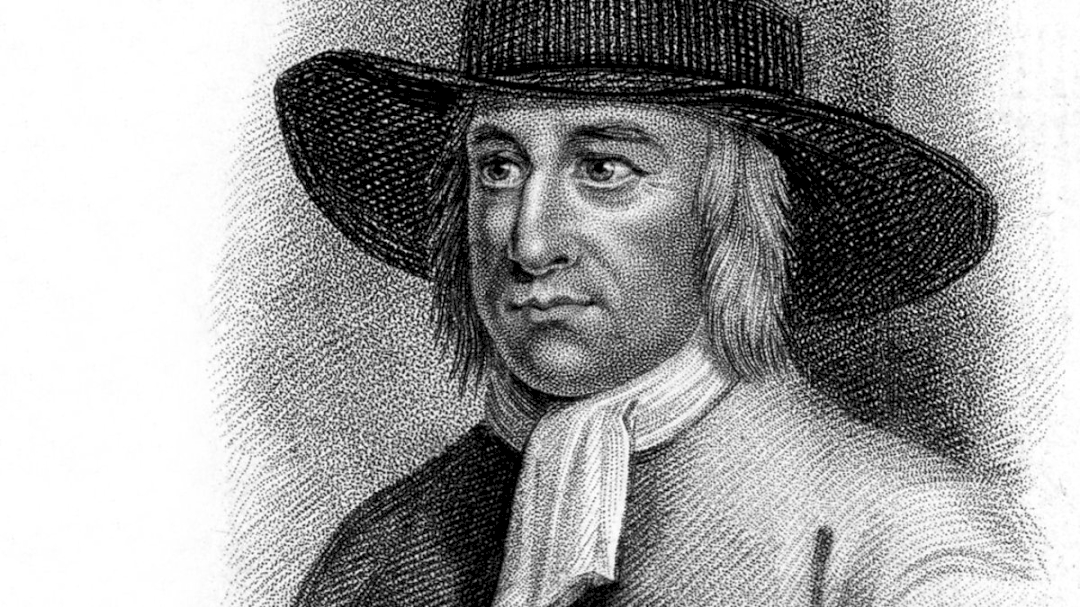
‘Hold fast the hope which anchors the soul, which is sure and steadfast, that you may float above the world’s sea.’
George Fox, from an epistle to Friends in America, 12 December 1675.
Historical background: The beginnings of Quakerism.
George Fox's teachings on Christian spirituality.
(See note * below.)
“Be still and cool in thy own mind and spirit from thy own thoughts, and then thou wilt feel the principle of God to turn thy mind to the Lord God, whereby thou wilt receive his strength and power from whence life comes, to allay all tempests, against blusterings and storms. That is it which moulds up into patience, into innocency, into soberness, into stillness, into stayedness, into quietness, up to God, with his power.”
George Fox: Letter to lady Claypole, 1658, Quaker Faith & Practice 2.18
Rufus M. Jones writes about George Fox's mental health experiences:
From his nineteenth year [1643] he [Fox] reveals serious abnormal traits of mind. He was greatly depressed, unable to sleep, filled with despair, beset with temptations to sin, sent forth from home as a lonely wanderer at the spur of an inward prompting. He looked at himself and said, “Was I ever so before?” The world seemed “dark and under a chain of darkness.” He was forlorn at home and afraid that he was doing wrong when he stayed away from home. Under the nervous strain and tension he had attacks of blindness, failed to emit blood when the surgeon tried to bleed him, and he showed other marks of disorganisation and unstable equilibrium. He sought help and guidance from priests and tender people, but they could not “speak to his condition.” One priest told his sorrows and troubles to servants and “milk-lasses”, another advised him to marry, a third recommended tobacco and psalm singing. “Empty hollow casks” they all seemed to the distraught youth.
Gradually the nervous strain relaxed. He began to see gleams of light and to get “openings,” which seemed to him to burst into his conscious ness from God. Insights like these broke in upon him: It is not breeding at Oxford and Cambridge that qualifies for ministry; God does not dwell in temples but in hearts; true believers must be born of God. Finally upon his distress there came a flood of light and he heard an interior voice say, “There is one, even Jesus Christ, that can speak to thy condition.” It seemed like a key put in his hand that unlocked all doors. He leaped in a flash to the fresh, first-hand discovery that Christ, whom the churches presented as dead, or as sitting in state in a far-away heaven, was alive and vitally present with him and in him; a revelation of God, so near, so real, that it was possible to know Him experimentally, and not merely as a fact of logic.
During this stage of his life Fox had many extraordinary experiences, such as mark the lives of mystics and prophets. His senses were hyper acute—he saw, heard, smelled and felt in unusual ways. Walking in the fields one day he heard the Lord say: “Thy name is written in the Lamb’s book of life,” and at another time: “Thou art in my love.” “I saw,” he says, “that there was an ocean of darkness and death; but an infinite ocean of light and love that flowed over the ocean of darkness. In that I saw the infinite love of God.”
From: The Life and Message of George Fox 1624-1924. A Tercentenary Address by Rufus M. Jones given at Haverford College, Haverford, Pennsylvania, May 17, 1924.
Biographies of George Fox:
1. Oxford Dictionary of National Biography: George Fox.
2. "Learn Religions" website: George Fox.
* Note: The Quaker Voices on Mental Health Steering Group does not necessarily accept or endorse content on 3rd Party websites that are referenced here.